

What’s the Difference Between SIL and SDA? NDIS Accommodation Types Explained

SIL, SDA, STA, MTA. Four NDIS acronyms that all sound like housing, and only one of them pays for a home. That one fact explains most of the difference between SIL and SDA in the NDIS. It’s also where most families get stuck.
This guide sets out what each support pays for, who it suits, how long it lasts and where to start. Every rule here comes from the NDIS website, and we’ve dated it so you know how current it is.
What is the difference between SIL and SDA?
SIL and SDA are two separate NDIS supports. Supported independent living (SIL) funds support workers who help or supervise you at home, around the clock. Specialist disability accommodation (SDA) funds the home itself, built for people with extreme functional impairment or very high support needs. Some participants have both.
Think of it this way. SIL pays for people. SDA pays for the building.
SIL funds the workers who help with showering, cooking, cleaning and getting through the day. It can’t pay rent or groceries. SDA pays the SDA provider for a home with features like wide doorways, ceiling hoists or extra-strong walls. You still pay a reasonable rent contribution and your own bills.
The NDIS makes the same point in its own explanation of SIL and SDA: SDA is the housing, and it doesn’t cover the support workers inside it.
Can you have SIL and SDA at the same time?
Yes. Some participants have both in their plan. The NDIA assesses each one on its own, so approval for one doesn’t guarantee the other.
A common set-up looks like this. SDA funds the home. SIL funds the roster of workers. The participant pays the rent and the power bill from their own income.
A quick example
Picture a participant who uses a wheelchair and needs help through the day and overnight. SDA might fund a fully accessible home. SIL might fund the workers who help with personal care and stay overnight. Whether this person gets either support depends on their plan and their evidence, not on the example.
What does SIL pay for?
Supported independent living is funding for a support worker to help or supervise you 24 hours a day, 7 days a week. You might share workers with housemates or have your own, depending on your needs.
The NDIS says SIL may suit you when you need a worker to:
stay with you 24 hours a day, including overnight
help you with daily activities for at least 8 of those hours
give some help or supervision for the rest of the time.
SIL doesn’t cover rent, groceries or other day-to-day costs. Self-directed arrangements, where you choose, plan and roster your own workers, don’t count as SIL.
Shared homes only work when the people in them suit each other. Our supported independent living service in Cairns runs a compatibility and risk assessment before every placement, including urgent ones.
What does SDA pay for?
Specialist disability accommodation is housing for people with extreme functional impairment or very high support needs. Other than SDA, the NDIS doesn’t fund housing. Most participants own, rent or live in social housing.
SDA homes fall into four design categories:
- Improved liveability: better physical access and features for people with sensory, intellectual or cognitive impairment, such as high-contrast walls and floors.
- Fully accessible: a high level of physical access, for example for people who use a wheelchair at home.
- Robust (the official NDIS category name): very strong, durable housing that suits people who need help with complex behaviours.
- High physical support: the highest level of access, which can include ceiling hoists, backup power and home automation.
A registered provider has to enrol each home with the NDIS. You sign a service agreement, record the SDA provider in your plan and pay a reasonable rent contribution. That rent can’t go above the maximum reasonable rent contribution (MRRC) the NDIS sets.
You’ll often see it written as “specialised disability accommodation”. The official NDIS term is specialist. Read more about SDA and the supports that sit around it.
Is STA the same as respite?
Mostly, yes. Short-term accommodation (STA) gives you a short supported stay away from home so your usual carers can take a break. That break helps them keep caring for you afterwards. Some providers call it short-term respite. The NDIS website calls it short-term accommodation.
You may be able to get STA funding when you:
live with your main informal supports, like family or a carer, or get daily drop-in support
get more than 6 hours a day of disability-related support from those informal supports.
According to the NDIS rules on short-term accommodation, it’s usually funded for up to 28 days a year. You can use it flexibly, for example in a block of up to 14 days or one weekend a month.
STA funding can pay for:
help with everyday activities like showering, cooking and toileting
standard accommodation, like a respite house, motel, cabin or short-stay rental
support at home or in a homestay, for people who usually need overnight support.
Worth knowing, because older guides get this wrong. STA funding can’t pay for food or meals. It also can’t pay for holidays, cruises, airfares, theme parks, cinema or sporting events. And it isn’t crisis accommodation.
What’s the difference between STA and MTA?
STA is a short break. MTA is a bridge to your next home.
Medium-term accommodation (MTA) pays for somewhere to live for up to 90 days when you can’t move into your long-term home yet. The NDIS funds it only in specific situations:
you’re waiting for an SDA vacancy, or for home modifications to finish
you’re leaving hospital and you’re eligible for SDA, SIL, individualised living options or home modifications
you’re leaving the justice system and you’re eligible for SDA while you wait for a vacancy.
MTA is a one-off support, and it isn’t emergency housing. It covers the accommodation only. Food, internet, electricity and personal care sit outside it, though the rest of your plan can still pay for care during the stay. Here’s how our medium-term accommodation for people between homes works.
The short version: STA gives carers a break, up to 28 days a year, and it can repeat. MTA fills a gap between homes, up to 90 days, once.
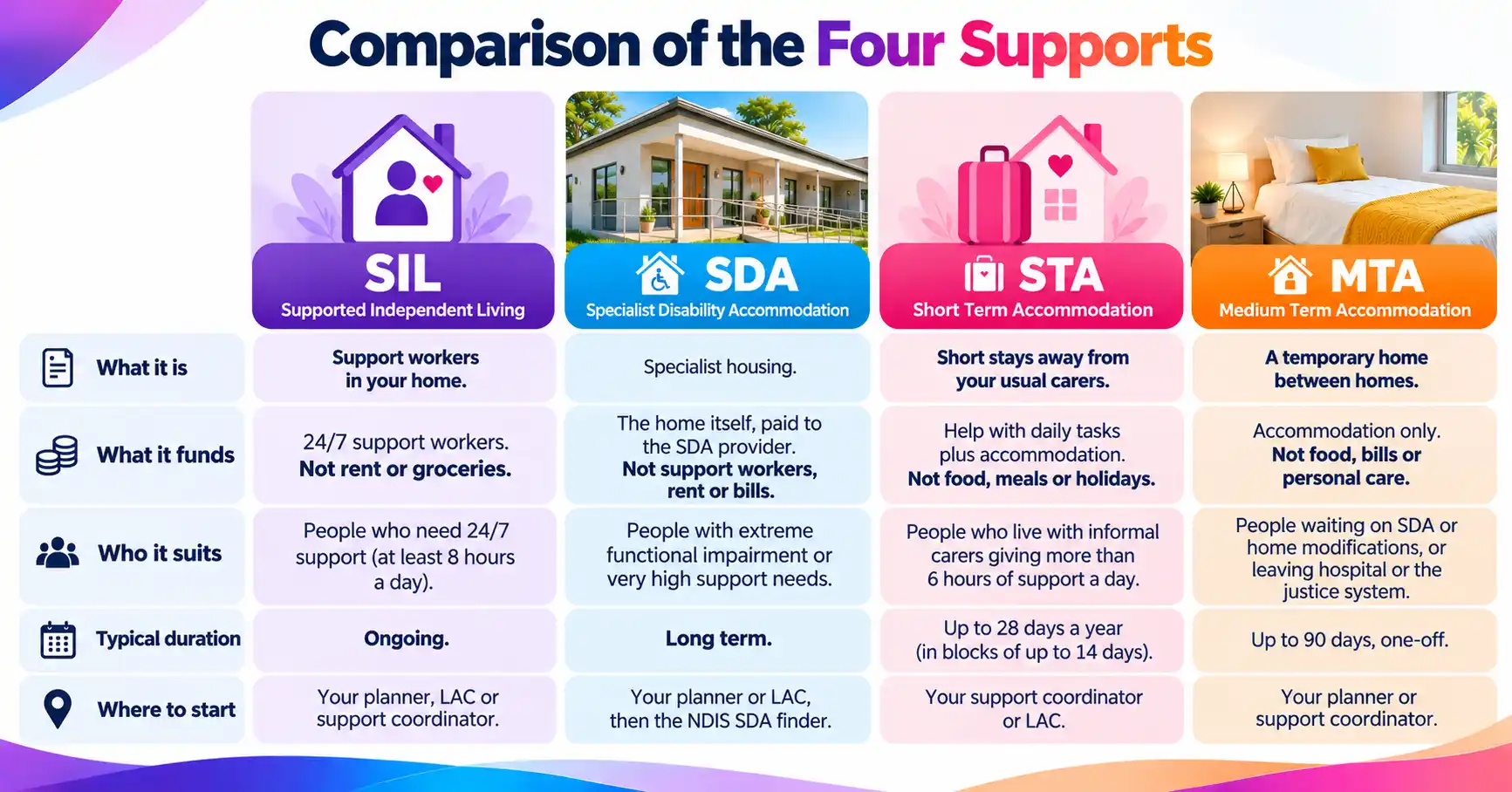
How do SIL, SDA, STA and MTA compare?
| Support | What it is | What it funds | Who it suits | Typical duration | Where to start |
|---|---|---|---|---|---|
| SIL | Support workers in your home. | Workers who help or supervise you around the clock. Not rent or groceries. | People who need 24/7 support, with hands-on help for at least 8 hours a day. | Ongoing. | Your planner, LAC or support coordinator. |
| SDA | Specialist housing. | The home itself, paid to the SDA provider. Not support workers, rent or bills. | People with extreme functional impairment or very high support needs. | Long term. | Your planner or LAC, then the NDIS SDA finder. |
| STA | Short stays away from your usual carers. | Help with everyday tasks plus standard accommodation. Not food, meals or holidays. | People who live with informal carers giving more than 6 hours of support a day. | Usually up to 28 days a year, in blocks of up to 14 days. | Your support coordinator or LAC. |
| MTA | A temporary home between homes. | Accommodation only. Not food, bills or personal care. | People waiting on SDA or home modifications, or leaving hospital or the justice system. | Up to 90 days, one-off. | Your planner or support coordinator. |
Source: ndis.gov.au, checked 8 October 2026. LAC means local area coordinator.
Which NDIS accommodation support do I need?
That depends on your plan, your evidence and what the NDIA decides is reasonable and necessary. Only your planner, LAC or support coordinator can confirm what fits. These situations show where most people start the conversation:
- You need help or supervision around the clock, at home, every day. Ask about SIL. Here’s how our SIL support works across Cairns.
- Your home can’t be made safe or accessible, even with modifications. Ask about SDA.
- You live with family who do most of your care, and they need a break. Ask about STA.
- You have somewhere to go, but you can’t move in yet. Ask about MTA.
Family carer running on empty? Short-term accommodation exists for exactly this. See how our short-term accommodation stays work, then talk to your support coordinator about adding STA to your plan.
Still not sure which one fits? Our team is based at 63 Mulgrave Road, Parramatta Park. We support participants across Cairns, the southern corridor and Innisfail, and urgent referrals go straight to management. Talk to our Cairns team or call 0435 330 666.
What changed for NDIS accommodation supports in 2026?
Three changes matter here, plus one that’s still only proposed.
- SIL providers must be registered. From 1 October 2026, only providers that are registered, or applied to register before that date, can deliver SIL. Your plan and funding don’t change. People who organise or employ their own workers don’t need to change anything.
- A new pricing schedule replaced the old price guide. The Minister for Disability and the NDIS made the first pricing determination under the NDIS Amendments (Securing the NDIS for Future Generations) Act 2026. The NDIS pricing schedule for 2026-27 took effect on 24 September 2026, replacing the Pricing Arrangements and Price Limits document. The maximum prices apply to NDIA-managed and plan-managed participants.
- The NDIS website uses the name short-term accommodation. Guides that say “short-term respite” are describing the same support.
- Still proposed: differentiated pricing. This would set different price limits for registered and unregistered providers. The NDIA’s pricing review recommended it start on 1 January 2027, and the government is still consulting. Nothing has changed yet.
NDIS rules change often. Before you make a decision, confirm the current position with your planner, LAC or support coordinator.
FAQ section
Can I have SIL and SDA at the same time?
Yes. Some NDIS participants have both SIL and SDA in their plan. SDA pays the SDA provider for the home, SIL pays for the support workers, and you pay the rent and bills. The NDIA assesses each support separately, so approval for one doesn’t mean approval for the other.
Does SIL pay for rent?
No. SIL funds support workers who help or supervise you at home. It can’t pay rent, groceries or other day-to-day living costs, which come from your own income. SDA residents pay their SDA provider a reasonable rent contribution, and the NDIS caps that amount at the maximum reasonable rent contribution.
Is STA the same as respite?
Largely, yes. Short-term accommodation gives you time apart from your usual carers so they can rest and keep caring for you. Some providers call it short-term respite. The NDIS usually funds up to 28 days a year, used flexibly, for example in blocks of up to 14 days or one weekend a month.
Can STA funding pay for meals or a holiday?
No. Under current NDIS rules, short-term accommodation funding can’t pay for food or meals, holiday packages, cruises, airfares, theme parks, cinema or sporting events. It covers help with everyday activities and standard accommodation, such as a respite house, motel or cabin. Some older guides still list meals as included, so check before you book.
How long can MTA last?
Medium-term accommodation can last up to 90 days, or about three months. The NDIS funds it as a one-off support when you can’t move into your long-term home yet, for example while you wait for an SDA vacancy or home modifications. It covers accommodation only, not food, bills or personal care.
Does my SIL provider have to be NDIS registered now?
Yes. Since 1 October 2026, SIL can only be delivered by providers that are registered, or that applied to register before that date. Your NDIS plan and funding stay the same. Participants who organise or employ their own support workers don’t need to change anything. Ask your provider to confirm their registration status.
Who decides which NDIS accommodation support I get?
The NDIA decides, based on your disability support needs, your goals, your evidence and whether the support is reasonable and necessary. Your planner, local area coordinator or support coordinator can help you gather reports and ask for the right support. Providers can explain the options, but they can’t promise you funding.

Compassionate Community Care
Part of the Compassionate Community Care team — sharing person-centred insights, NDIS guidance, and stories from across Cairns to support participants, families, and support coordinators.
View all articles