

What Is NDIS Forensic Support? A Guide to NDIS Support After Justice System Involvement


A family member is due home from custody next month. Or a participant you coordinate has just been placed on a community order. Either way, the same question lands on your desk: what will the NDIS pay for now, and what won’t it?
This guide explains NDIS support after justice system involvement in plain English. It covers what the NDIS funds, what stays with the justice system, how support changes at each stage and what to prepare. It’s written for families, carers and support coordinators, with a Queensland focus. It isn’t legal advice.
What is NDIS forensic support?
Forensic support isn’t a single NDIS funding category. It’s a common name for disability supports for a person who has had contact with the justice system, such as custody, bail, parole or a forensic order. The NDIS funds disability-related supports, while the justice system stays responsible for supervision, order conditions and offence-related programs.
You won’t find a line called “forensic support” in an NDIS plan. Providers use the term for ordinary NDIS supports, such as daily living support, behaviour support, support coordination and therapy, delivered by staff who understand justice settings. The word “forensic” comes from the legal system. In Queensland it often refers to a forensic order made by the Mental Health Court.
Who may need NDIS support after justice system involvement?
The NDIS treats a person as involved in the justice system when they are:
- in custody, such as prison, remand, youth detention or a secure mental health facility
- awaiting or serving a sentence
- reporting to corrections because of bail, probation or parole
- on a community-based order or a leave of absence order
- under a forensic order.
Contact with the justice system doesn’t end NDIS participation. A participant who goes into custody stays a participant, and their plan stays in place until it’s reassessed. People in custody can also apply for the NDIS. The NDIA encourages them to apply well before a possible release date, and it may decide faster when release is close.
What does the NDIS fund, and what is the justice system responsible for?
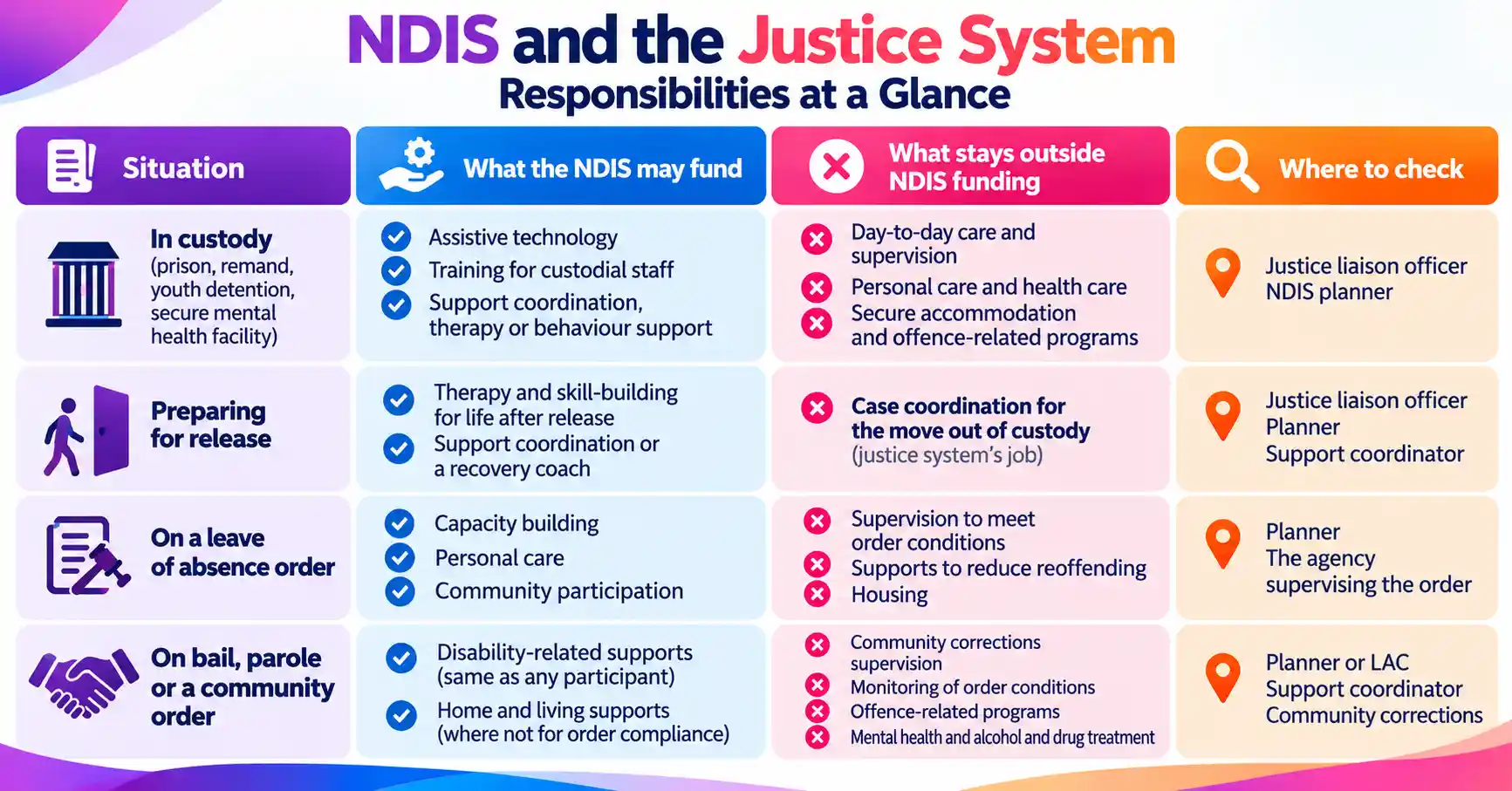
The NDIS funds supports linked to a person’s disability. The justice system funds what relates to custody, supervision and offending. The NDIS Justice system guideline sets out the split, and it’s the first document to check.
| Situation | What the NDIS May Fund | What Stays Outside NDIS Funding | Where to Check |
|---|---|---|---|
| In custody (prison, remand, youth detention, secure mental health facility) | Some assistive technology, disability-specific training for custodial staff, and capacity building such as support coordination, a recovery coach, therapy or behaviour support | Day-to-day care, supervision, personal care, health care, secure accommodation and offence-related programs. The justice system also decides what can be delivered inside. | Justice liaison officer, NDIS planner |
| Preparing for release | Disability-related therapy, skill-building for life after release, and support coordination or a recovery coach working alongside justice case management | Case coordination for the move out of custody (the justice system’s job) | Justice liaison officer, planner, support coordinator |
| On a leave of absence order | Capacity building, personal care, and help to take part in social and community activities | Supervision to meet order conditions, supports to reduce reoffending, and housing | Planner, the agency supervising the order |
| On bail, parole or a community order | Disability-related supports, the same as for any participant. Home and living supports only where their main purpose isn’t order compliance or reducing reoffending. | Community corrections supervision, monitoring of order conditions, offence-related programs, and mental health and alcohol and drug treatment | Planner or LAC, support coordinator, community corrections |
Source: NDIS Justice system guideline, published 7 April 2025, checked 8 October 2026.
Every decision still depends on the person’s plan, their evidence and whether the NDIA finds a support reasonable and necessary. A forensic order can mean detention or living in the community, so ask a justice liaison officer how these rules apply to a specific order.
How does NDIS support work before release, on release and back in the community?
Support changes at each stage, and the handovers are where things slip. Here’s what the NDIS guideline says about each one.
Before release
Start early. For a current participant, the NDIA may build a new plan before release so supports are ready on the day. Release can also come earlier than expected. When it does, the NDIS works with everyone involved to get supports in place.
Justice liaison officers (JLOs) help with this. They’re NDIA staff who connect people in custody, or coming back to the community, with NDIS supports. They work with justice services and NDIA planners, and help sort out problems between the NDIS and other services. The NDIS page on justice liaison officers explains their role.
On release
Housing, rosters, medication, transport and any clinical plans need to be ready before the person leaves custody. At Compassionate Community Care, our forensic support service and our custody to community transition support both start planning before the release date for this reason.
Fictional example, not a real person: Alex is an NDIS participant with an acquired brain injury who expects parole in about three months. Alex, a support coordinator, the JLO and the custody case manager meet to plan housing, therapy and daily support. The NDIA reviews Alex’s plan so supports start on release day. Parole supervision stays with community corrections.
Back in the community
In the community, the NDIS funds disability supports the same way it does for any participant. The NDIA checks in after release, and again if a sentence changes. A participant can ask for a plan reassessment when their support needs change. They can also ask for an internal review of a plan decision within 3 months of getting the plan.
How do behaviour support and restrictive practices work?
Behaviour support looks at why behaviours of concern happen. Its aim is to reduce, and ideally remove, the need for restrictive practices.
The NDIS Quality and Safeguards Commission regulates five restrictive practices: seclusion, and chemical, mechanical, physical and environmental restraint. An NDIS behaviour support practitioner writes the behaviour support plan.
For providers, the NDIS Commission’s rules for implementing providers set firm requirements:
- Only registered providers can use regulated restrictive practices.
- For ongoing use, the provider engages a specialist behaviour support provider. An interim plan is due within 1 month of first use, and a comprehensive plan within 6 months.
- The provider gets authorisation from the state or territory where the person lives.
- The provider reports its use every month, including months with no use.
- Unauthorised use is a reportable incident, due within 5 business days.
In Queensland, the state government authorises restrictive practices, not the NDIS Commission. Queensland is reviewing its framework, so providers should confirm the current process with the Queensland Government before relying on it.
One line matters for justice settings. The NDIS can fund disability-related behaviour support, including in custody. Clinical programs aimed at offending, such as offence-related psychology or anger management, stay with the justice system.
Families can ask any provider whether a behaviour support plan is in place, who wrote it and how staff are trained to follow it. Our behaviour support service works with participants, families and allied health professionals on behaviour support plans.
What does a support coordinator do when someone leaves custody?
A support coordinator connects the person’s NDIS plan with everything else going on. Before release, the NDIS may fund support coordination to work alongside justice case management. After release, the coordinator helps the person find providers, set up supports and keep the plan working.
Good coordination means talking to everyone: the person, family, the JLO, community corrections, guardians, treating teams and providers. It also means clear lines. The coordinator arranges disability supports. Community corrections monitors order conditions. Our support coordination team in Cairns helps participants understand their plan and arrange the supports in it.
How do forensic orders work in Queensland?
In Queensland, the Mental Health Court decides whether a person charged with a serious offence was of unsound mind at the time, or is fit for trial. It works under the Mental Health Act 2016.
When the person has impaired decision-making ability, the court can make a forensic order (disability). The Queensland Public Advocate’s guide to the forensic disability system says this kind of order can mean:
- detention in the Forensic Disability Service
- detention in an authorised mental health service
- involuntary treatment while the person lives in the community.
Only the Mental Health Review Tribunal, or the Mental Health Court on appeal, can revoke a forensic order. The Forensic Disability Act 2011 and the Disability Services Act 2006 also form part of Queensland’s forensic disability system.
These are legal matters. For questions about a charge, a court or an order, call Legal Aid Queensland’s legal information line on 1300 65 11 88. Aboriginal and Torres Strait Islander people can contact ATSILS on 1800 012 255. Outside business hours, that number runs a custody notification service only.
What should families and referrers prepare?
Good information makes planning faster and safer. Before you contact the NDIA or a provider, gather:
- the person’s NDIS number and current plan, or proof that an access request is under way
- their custody or order status, and any likely release date
- contact details for the JLO, community corrections officer, guardian or Office of the Public Guardian, and treating team
- any current behaviour support plan, risk assessment or clinical reports
- what the person wants, including where they’d like to live and who they want support from
- the person’s consent to share information between agencies.
What to ask a provider
- Which NDIS registration groups do you hold, and are you registered to use regulated restrictive practices?
- Do you work with an NDIS behaviour support practitioner?
- How early do you start planning for release day?
- What clinical support is available, and who provides it?
- How do you assess risk and compatibility in shared homes?
- How will you work with community corrections, guardians and the JLO, and where do your responsibilities stop?
- Who will be our named contact, and how do urgent issues get escalated?
- Which suburbs and towns do you cover?
How do you get started in Cairns and Far North Queensland?
Start with three conversations: the person, their NDIS planner or JLO, and a support coordinator. Then talk to providers who know justice settings.
Compassionate Community Care is based at 63 Mulgrave Road, Parramatta Park. We support NDIS participants on forensic orders or with justice system involvement, including people leaving custody. Forensic and mental health nurses sit within our clinical team. We don’t plan in a vacuum, either. We work directly with justice agencies, the Office of the Public Guardian, guardians, treating teams and the NDIA.
On the map, that’s Cairns, Manoora, Mooroobool, Woree, White Rock, Bentley Park and Edmonton, plus Innisfail further south. Two things we won’t skip: a risk and compatibility assessment before anyone moves into a shared home, and a fast line to management when a referral is urgent.
Support coordinators and families: send us the basics about the person and what they need. We’ll tell you straight whether we can help, when we could start, and what happens next. Start a referral with our team or give us a ring on 0435 330 666. You can also read how our forensic support referrals work.
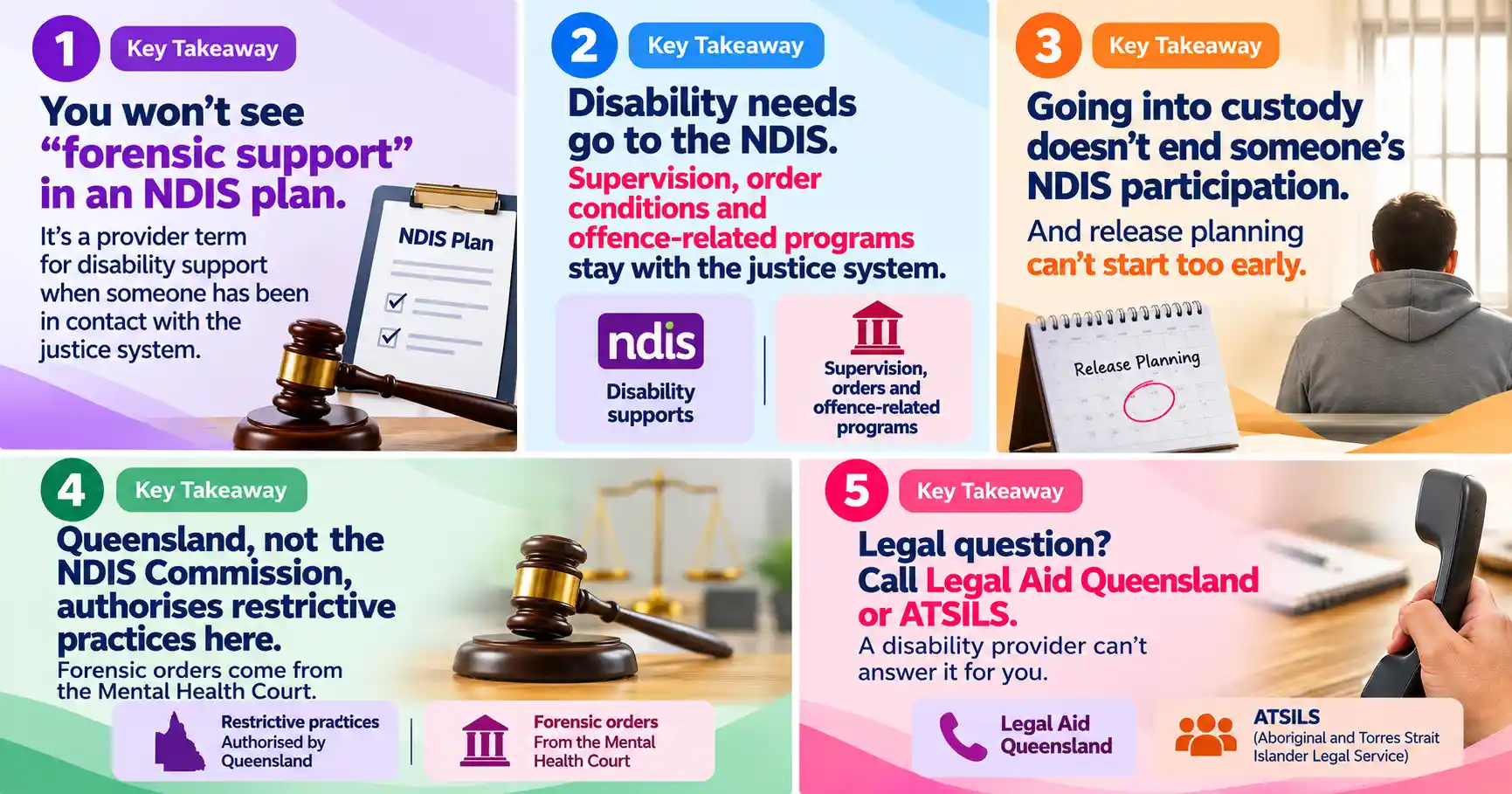
Key takeaways
- You won’t see “forensic support” in an NDIS plan. It’s a provider term for disability support when someone has been in contact with the justice system.
- Disability needs go to the NDIS. Supervision, order conditions and offence-related programs stay with the justice system.
- Going into custody doesn’t end someone’s NDIS participation. And release planning can’t start too early.
- Queensland, not the NDIS Commission, authorises restrictive practices here. Forensic orders come from the Mental Health Court.
- Legal question? Call Legal Aid Queensland or ATSILS. A disability provider can’t answer it for you.
NDIS and Queensland rules change. Before you act, check where things stand with the NDIA, your planner, LAC or JLO. For anything legal, ask a lawyer.
FAQ section
Does someone keep their NDIS plan in custody?
Yes. Going into custody doesn’t end someone’s NDIS participation, and their plan keeps running until the NDIA reassesses it. Before release, the NDIA may write a new plan so supports are ready back in the community. While someone is in custody, plan length lines up with the minimum sentence. Expect a check-in after release, too.
What will the NDIS pay for while someone is in prison?
A fairly short list. Inside, the NDIS may fund some assistive technology, training for custodial staff about the person’s disability, and capacity building like support coordination, therapy, a recovery coach or behaviour support. Day-to-day care, supervision, personal care and health care belong to the justice system. It also decides what’s allowed in.
Can NDIS funding cover bail or parole conditions?
No. The NDIS funds disability-related supports, not order compliance. It won’t fund supervision to meet the conditions of an order, or supports aimed at reducing reoffending. It also won’t fund SIL or other home and living supports where the main purpose is meeting a community order. That job belongs to community corrections.
What does an NDIS justice liaison officer do?
A justice liaison officer (JLO) works for the NDIA. Their job is to connect people with disability in the justice system to NDIS supports. In practice, that means explaining how to apply, working with planners on plans in custody and on release, and sorting out snags between the NDIS and justice or mainstream services.
What is a forensic order (disability) in Queensland?
A forensic order (disability) is an order the Mental Health Court can make for a person with impaired decision-making ability charged with an offence. That can mean detention in the Forensic Disability Service or an authorised mental health service. Or the person lives in the community, with involuntary treatment. Either way, the Mental Health Review Tribunal reviews the order.
Who authorises restrictive practices in Queensland?
The Queensland Government authorises restrictive practices for people with disability in Queensland, not the NDIS Commission. The Commission regulates the five restrictive practices and the providers that use them. Queensland is reviewing its framework, so providers should confirm the current authorisation process with the Queensland Government before they rely on it.
Where can families get legal help in Queensland?
For questions about a charge, a court or an order, call Legal Aid Queensland’s legal information line on 1300 65 11 88. Aboriginal and Torres Strait Islander people can contact ATSILS on 1800 012 255. Outside business hours, ATSILS runs a custody notification service only. NDIS providers can’t give legal advice.

Compassionate Community Care
Part of the Compassionate Community Care team — sharing person-centred insights, NDIS guidance, and stories from across Cairns to support participants, families, and support coordinators.
View all articles